
Treatment update · September 29, 2026
How Laverdia works
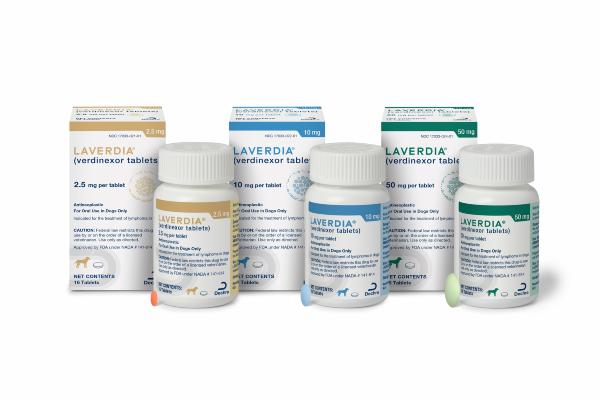
Laverdia (verdinexor) is an oral treatment for dogs with lymphoma. It blocks XPO1, a protein involved in moving growth-control proteins out of the cell nucleus. By inhibiting XPO1, verdinexor can keep those proteins in the nucleus, where they may help slow cancer-cell growth and promote cell death.
The practical advantage is that it is given at home as a tablet twice a week, with at least 72 hours between doses.
What the FDA study showed
The field study supporting full FDA approval was prospective, randomized, masked and placebo-controlled. It enrolled 160 dogs with measurable B-cell or T-cell lymphoma. Sixty percent were newly diagnosed and 40% had relapsed after previous chemotherapy. All 160 dogs were included in the safety analysis; 134 were included in the effectiveness analysis: 106 received Laverdia and 28 received placebo tablets.
The primary endpoint was time to progression. The median was 37 days with Laverdia and 23 days with placebo. The difference was statistically significant.
An earlier single-arm study included 58 dogs. An objective response was reported in 20 dogs, or 34.5%, with a median response duration of 18 days. That study used earlier formulations and was not a direct comparison with standard chemotherapy.
These studies show that verdinexor has measurable anticancer activity in canine lymphoma. They do not show that it is equivalent to a multi-drug chemotherapy protocol such as CHOP.
Side effects reported in the study
Among 127 dogs treated with Laverdia in the pivotal study, anorexia was reported in 74%, vomiting in 61%, lethargy in 61%, weight loss in 52%, and diarrhea in 43%. Elevated ALT was reported in 22% and thrombocytopenia in 18%. Serious adverse events were reported in 22% of treated dogs.
More than half of the dogs that developed anorexia received additional medication to support appetite. The prescribing information also calls for regular blood and chemistry monitoring. Because verdinexor is an antineoplastic drug, owners are instructed to use chemotherapy-resistant gloves when handling the tablets and when cleaning up urine, feces, saliva or vomit during treatment and for three days after the last dose.
Where it may fit
Laverdia may be considered when an owner does not choose multi-drug chemotherapy, when a dog is not a good candidate for a more intensive protocol, or when an oncologist is looking for another systemic treatment option.
For owners comparing Laverdia with a standard lymphoma protocol, the useful numbers are in the FDA data: how many dogs were treated, how long disease control lasted, and how often side effects occurred.
FDA full-approval announcement · Official prescribing information from Dechra